
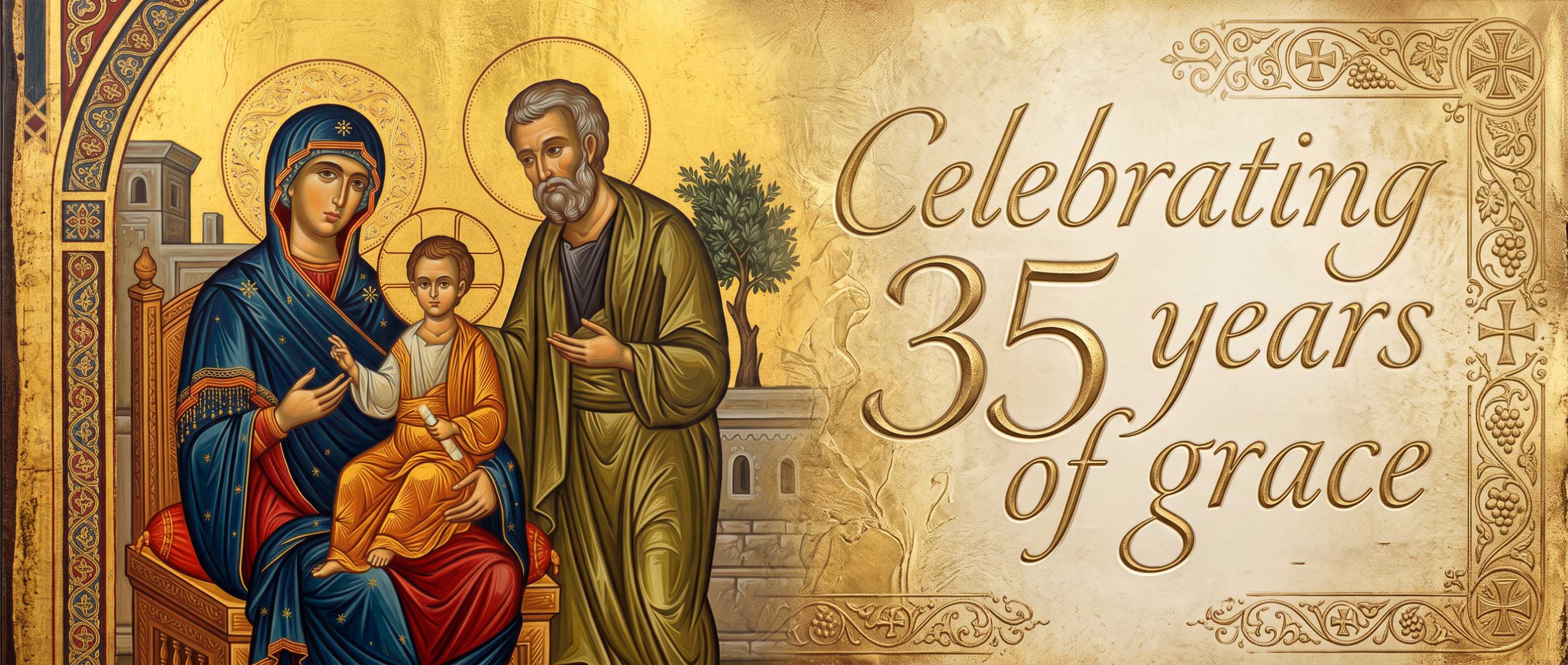
1. God often shows the destination before He shows the road
The vision came years before the means. I have learned not to dismiss something simply because I cannot yet see how it could happen. Sometimes God allows us to glimpse where He is leading before He reveals how we will get there. The vision is His invitation; the journey teaches us trust.
God may show us enough to begin trusting Him, but not enough to stop needing Him.
2. Treasure what God gives you in prayer
I wrote the vision down and put it away. For five years, nothing seemed to happen. But what seemed dormant was not dead. I have learned that what God plants does not have to appear active for Him to be at work. Everything under the sun has an appointed time to unfold, and when that time came, the vision I thought I had put away began quietly coming to life.
What seems hidden may simply be waiting for God’s appointed time.
3. Delay is not necessarily refusal
Those five years were not wasted years. What felt like waiting was preparation. God was arranging people, circumstances – and my own heart. Waiting can feel empty when we judge it only by what we can see, but God can be doing some of His most important work beneath the surface.
A delay in our timetable does not mean a delay in God’s purpose.
4. Never underestimate what God can begin with something small
The Sanctuary did not begin with a grand opening. It began with prayer, borrowed space and a few books. What seemed so small at the time was already carrying the seed of something much greater. I have learned never to measure the importance of a beginning by its size. When God is in it, even the smallest seed can carry a purpose far greater than we can see.
Never measure the future of something God has planted by how small it looks today.
5. Give God what is in your hands
I did not have everything a Sanctuary would need. I had no great resources or certainty about how it would all come together. I simply had a desire to serve, what little was available to me, and a willingness to begin.
I gave God what I had, and He did the multiplying. Over the years I have learned that God is not waiting for us to have everything in place before He can use us. He asks for our willingness, our trust and our yes – and from these, He can do far more than we could ever accomplish on our own.
Our part is to offer what is in our hands. The multiplication belongs to God.
WHEN GOD BEGAN WITH ME
6. Sometimes God begins His work by turning the light on us
This happened during those first years, before the Sanctuary existed. Two friends from the prayer group took me aside and told me that they had noticed jealousy or envy in me when other people’s spiritual gifts were recognized. I thanked them outwardly. Inwardly, I was furious. “Who do they think they are?” I thought. “They have issues too. I am not going back to that prayer meeting.”
But from Friday morning through the weekend, I kept bringing it to the Lord. Instead of simply defending myself, I finally asked Him: “Show me. Is there something in me, Lord, that I cannot see? Why does this hurt so much?”
By Sunday afternoon, the Lord allowed me to recognize that there was some jealousy – but beneath it was something deeper. Growing up, I had not experienced much affirmation or praise. Somewhere within me was a wound that wondered whether there was anything special or valuable in me at all. When gifts were admired in others, that old wound was being touched. Once I could see it, I could surrender it. The Lord brought healing where I had first felt only humiliation. I went back to those two friends, embraced them and thanked them for having the courage to tell me the truth.
Not everything that hurts us is meant to harm us. Sometimes the truth hurts because God is touching something He intends to heal.
7. The prayer that changed the way I saw myself
The Lord already knows what is hidden within us – our wounds, fears, jealousies, resentments and insecurities. We do not have to hide them from Him or pretend they are not there. I learned that healing begins when I can stand honestly before the Lord and say, “Show me what is in my heart, and help me to see it as You see it.”
His light is not meant to shame or condemn us, but to reveal what needs His mercy. What we have the courage to bring into His light, He can begin to heal and set free.
Honesty before God is not something to fear; it is often the doorway through which healing enters.
8. God did not wait for me to become perfect
There were many times when I felt inadequate for what the Lord was asking of me. I did not feel especially qualified or equipped for the work that was unfolding. But over the years I came to understand that God was not asking me to have all the answers or to be perfect before He could use me. He was asking me to be available.
When we place a willing heart in His hands, He can teach us, form us and use us in ways we could never have imagined. Our limitations do not prevent God from working; sometimes they are the very place where His grace becomes most visible.
God does not need me to be enough; He asks me to trust that He is.
9. I discovered that the grace was waiting on the other side of yes
I often wanted to feel certain, capable or ready before taking the next step. But that was rarely how the Lord worked with me. Again and again, He asked for my yes before I could see how everything would be accomplished.
Only after stepping forward did I discover that the grace I needed was already waiting for me. I learned that God does not always give us the strength for something before we agree to do it. Sometimes He waits for our trust – and then gives us the grace for the step we have just taken.
The yes was mine to give. The grace was His to provide.
WHEN JESUS CAME TO STAY
10. For one year, we carried Jesus there every day
When the Sanctuary first opened, we longed to have Eucharistic Adoration, but permission was not initially given for the Blessed Sacrament to remain there. So for an entire year, every morning I went to another community, collected the Blessed Sacrament and brought Jesus to the Sanctuary chapel. Every evening, I took Him back to the tabernacle.vbMorning after morning. Evening after evening.
It required commitment, but it never felt meaningless, because we knew that if the Sanctuary was truly to be a place of prayer, refuge and peace, then Jesus had to be at its centre. We could have filled the building with many good things, but the greatest treasure we could offer anyone who entered was not something we could provide ourselves – it was His Presence.
Eventually, permission was granted for the Blessed Sacrament to remain with us. What a grace that was. The One whom I had carried to the Sanctuary each morning could now remain there day and night.
He came. He remained. And He has been faithful. Looking back, I realize that this was one of the first great lessons the Sanctuary taught me:
When we truly desire to make room for Jesus, love finds a way. And when He is given the centre, everything else finds its proper place around Him.
11. Some burdens need more than our words
Over the years, many things have taken place within the Sanctuary – Holy Mass, Eucharistic Adoration, prayer and prayer vigils, retreats, conferences, formation, assistance to families and countless conversations with people who simply needed someone to listen.
All of these are important. But I have learned that the greatest gift the Sanctuary can ever offer is not a programme, an event or even something we ourselves can do for another person. The greatest gift is the opportunity to encounter Jesus.
People may enter carrying burdens we know nothing about. Some come with grief, fear, broken relationships, financial difficulties, illness, disappointment or questions they cannot put into words. We may not know what to say or how to help them – but Jesus knows.
Sometimes our greatest ministry is simply to bring people into His Presence and allow Him to do what only He can do. We prepare the place, welcome the person, listen, pray and love – but Jesus is the One who reaches the places in the human heart that we cannot reach.
We make room for the encounter. He does the work within the heart.
12. The chapel door eventually had to lead somewhere else
The Sanctuary could never remain only a place where we came to pray. If we truly spent time before Jesus, then sooner or later He would send us beyond the chapel doors. And He did.
We began helping families with groceries and other needs. We visited homes. We prayed with people who were sick, discouraged or struggling. We accompanied families through difficult seasons. We brought Our Lady into homes, shared the message of Divine Mercy and tried, in whatever small ways we could, to bring hope where hope was needed.
I began to understand that prayer and service are not two separate things. What we receive at the feet of Jesus must eventually pass through our hands to someone else. The Eucharist teaches us this beautifully. We come to receive Christ – and then we are sent forth to carry Christ into the world.
There will always be someone who needs more than our words: someone who needs to be noticed, listened to, fed, visited, encouraged, forgiven or simply reminded that God has not forgotten them.
Prayer draws us into the Heart of Jesus; love sends us out carrying something of that Heart to others.
13. God kept sending the people we needed
One of the great gifts of these thirty-five years has been the people God placed along the way. Priests came who celebrated Holy Mass, heard confessions, taught us and brought Jesus to us in the Eucharist. Friends, volunteers, benefactors and members of the community gave their time, gifts, resources, prayers and love. Some quietly did things that few people ever saw. Others arrived at exactly the moment we needed what they were able to give.
Not everyone remained for the entire journey. Some walked with us for many years; others were with us only for a particular season. In the beginning, I did not always understand this. But over time I learned that God sends different people for different parts of the journey.
No one person carries the whole mission. One plants, another waters, another encourages, another provides – and God gives the growth.
This also taught me something about surrender. The Sanctuary does not belong to us, nor does its future depend upon us. If this work is truly God’s, then He knows whom to call, whom to send, whom to form and whom He will ask to carry it into the future. Our responsibility is to be faithful to the part He has entrusted to us and to recognize with gratitude the people He sends along the way.
God begins the work, God sends the labourers, and God remains responsible for what belongs to Him.
14. We needed $50,000. The cheque was for $50,000.
About twenty-six years ago, in our fourth location, we needed substantial funds to outfit a new building. People were generous and gave us three months to settle the bills. At the end of those three months, we still owed $50,000. There was no obvious source for it. We prayed simply: “Lord, this is Your work. If You want it to continue, You will have to provide what we need.”
A woman came to pray before the Blessed Sacrament. While she was there, she felt strongly that the Lord was asking her to make a donation to the Sanctuary. Later she placed a cheque in my hand.
I looked at the amount: $50,000. Exactly what we owed. I actually asked her whether she had made a mistake. She told me no – that was the amount she had felt the Lord asking her to give.
That experience did not teach me that God will always provide in the way I expect. It taught me that His knowledge of our need is exact, and His timing can leave no doubt about whose hand has acted.
We owed $50,000. God provided $50,000.
There are moments when you can only stand still and recognize whose work it really is.
15. Providence never meant that we could stop being responsible
Experiences of extraordinary provision never gave us permission to be careless. If anything, they made me more conscious that what God places in our hands is a trust.
Faith and responsibility belong together. We pray, but we also plan. We trust, but we also account carefully for what has been entrusted to us. We ask God to provide, while doing our part with prudence, honesty and gratitude.
Providence is not an excuse to avoid responsibility; it is an invitation to carry responsibility without fear.
16. I asked God for a sign. He sent a man looking for a Bible.
At another difficult point, I asked the Lord for a sign that the work was truly His. A vagrant came into the pharmacy asking for a Bible. He had exactly the amount needed to buy it. It was a small incident, easily overlooked by anyone else. But it arrived at precisely the moment I had been asking the Lord for reassurance.
Over the years I have learned not to demand signs from God, but I have also learned not to dismiss His tenderness when He chooses to reassure us. Sometimes He answers through something so simple and so perfectly timed that the heart recognizes His whisper.
God knows the difference between a heart demanding proof and a heart that simply needs encouragement to keep going.
LET GOD CHOOSE THE WORK
WHEN THE SANCTUARY HAD NO SANCTUARY
One of the most revealing chapters came when we had to leave our building. Everything was packed away in a warehouse. For about three months, the Sanctuary had no place from which to minister.
It was Advent.
The irony was impossible to miss. We were the Sanctuary of the Holy Family, and like the Holy Family, we were searching for a place. There seemed to be no room for us. For three months we wondered whether this was the end. Yet somewhere within me I could not believe that the Lord had raised up the Sanctuary simply for it to disappear like this.
Then a dear priest friend approached the Carmelite Sisters, asking whether we could use their home temporarily. They welcomed us. In time, another door opened and the Sanctuary found a home again. But something even more important was born during that homeless Advent: the words that clarified our mission.
To create a place where Christ can be born daily in our hearts, and in the hearts of all people.
For three months, we thought we were searching for a home for the Sanctuary. God was revealing what the Sanctuary was really meant to be.
Do not mistake an Advent for an ending.
17. We did not go looking for every ministry – many of them came looking for us
Over the years, one ministry seemed to lead naturally into another: Marian home visits, the Divine Mercy Ministry, evangelization in homes, reaching out to families in need, conferences, and many other opportunities the Lord placed before us. I began to recognize a pattern. What God wanted us to carry had a way of finding us. This taught me to listen before rushing to begin something simply because it was good. Not every good work is necessarily our work.
Discernment asks not only, “Is this good?” but also, “Lord, is this what You are asking of us?”
18. I stopped asking God simply to bless my plans
Every year, before a Divine Mercy Conference, I pray about the theme, the speakers, the format, what people need to hear and where they need healing. I do not want merely to organize a successful event. I want to know what the Lord desires to do.
This changed the way I understood ministry. It is easy to make our plans and then ask God to bless them. It is much more freeing to begin by asking, “Lord, what is Your plan? What do You want Your people to receive?” When we begin there, preparation itself becomes prayer, and the burden of making everything “work” no longer rests entirely on us.
I learned not to ask God simply to bless my plans, but to ask Him for His plan.
19. God knew every person who would walk through the door
After our conferences, people so often tell us, “That was exactly what I needed,” or “It felt as though that talk was meant for me.” We could never know all the stories walking through the door. God does. He knows the person who will sit quietly at the back, the family carrying a burden no one sees, the soul who has almost lost hope, the person who needs one particular word to begin again.
That is why prayer cannot be an addition to the work. Prayer is where the work begins. Before we know who will come, God already knows every name, every wound and every need.
God knows each soul before we ever meet them.
20. I had to learn that I was not the one who could heal anyone
We prepare. We speak. We pray. We listen. We offer our hands and feet. But when a heart is touched, a burden is lifted or a wound begins to heal, I know whose work that is. This has been one of the most freeing lessons of ministry. I do not have to be anyone’s saviour. I cannot enter another person’s heart and repair what is broken there. I can love, accompany and point toward Jesus. The rest belongs to Him.
Our task is availability. The transforming power belongs to God.
FAITHFULNESS IS NOT A NUMBERS GAME
21. I wondered whether we were doing something wrong
The Sanctuary community remained small. I looked at larger communities and sometimes wondered, “Are we doing something wrong?” Comparison can make us question fruit that God Himself has planted.
Eventually I learned to ask a different question – not “How large are we?” but “Are we faithful to what God has asked of us?” God does not give every community the same assignment, the same size or the same outward appearance.
Comparison asks whether we look successful.
Faithfulness asks whether we are doing what God asked.
22. I had to stop believing that small meant unsuccessful
People came and went, yet a small faithful handful kept carrying the mission. God is not limited by numbers. A small group can pray deeply, serve faithfully, welcome generously and become a place where lives are changed. The Gospel itself reminds us that God loves seeds, mustard seeds, a little yeast, a few loaves and fishes – things that appear insufficient until they are placed in His hands.
Fruitfulness is not always loud, visible or easily counted.
23. Some people were only meant to walk with us for a season
Ministry taught me that not everyone is meant to remain with us forever. Some people come for healing, some to serve, some to learn, some to help us grow, and some for reasons we understand only later.
At times departures can hurt, especially when we have shared deeply with someone. But love cannot become possession. We accompany people for the season God gives us, bless what He has done, and when the season changes, place them back into His hands.
People belong to God before they ever belong to a community.
WHAT PEOPLE TAUGHT ME ABOUT MYSELF
24. My father taught me to have a giraffe’s neck
My father gave me advice that has followed me through countless difficult conversations. Before speaking, he taught me to ask: “Is it helpful? Is it true? Is it kind? Is it necessary?”
He also told me to have a “giraffe neck” – to put a little distance between the thought and the words. In other words: do not let everything that enters the mind immediately leave the mouth.
Leadership often requires truth, correction and difficult conversations. But truth does not become more truthful because it is delivered harshly. I have learned to ask the Lord to purify not only what I say, but the spirit in which I say it.
A few seconds of grace between thought and speech can save years of regret.
25. Sometimes peace begins when I stop waiting for the other person
Years ago, there was a friend whom we had journeyed with through the prayer meetings during a very difficult season of her life. We prayed with her, supported her, and rejoiced when she eventually came to a much better place. Over time, however, our relationship changed. She began avoiding me, speaking to me in ways that hurt, and showing an attitude that I found difficult to understand. At first, I tried to overlook it, but little by little I realized that resentment was beginning to grow in my own heart.
One morning, after dropping my children to school, I felt very clearly in my heart: “Ask her forgiveness.” My immediate reaction was, “Lord, why should I ask her forgiveness? She is the one who has hurt me. She should be asking me.” But as I prayed, the Lord gently showed me that He was not asking me to take responsibility for what she had done. He was asking me to take responsibility for what I had allowed to grow within me. Resentment had begun to take root, and He wanted to free me from it.
I went to her home, telling myself that if she was not there, I would simply go home. But she was there. I told her that I had come to ask her forgiveness because I had allowed hurt and resentment to enter my heart, and I did not want to carry those feelings any longer. As I spoke, she began to cry. She told me that she should be asking my forgiveness because of the way she had been treating me.
In that moment, the wall between us came down. Looking back, I realize that if I had waited for her to make the first move, that wall might have remained for a very long time. The Lord was not asking me to decide who was right or wrong. He was asking me to choose love over pride and freedom over resentment.
That experience taught me that humility is not accepting blame for things that are not ours. It is being willing to let God search our own hearts and show us where we need healing. Sometimes we spend so much time waiting for another person to change that we do not notice what the situation is doing within us. When I allowed God to deal with my own heart first, He opened a door to reconciliation that I could never have forced myself.
Sometimes peace does not begin when the other person says, “I’m sorry.” Sometimes it begins when we are willing to say, “Lord, show me what You want to heal in me.”
Humility is not about deciding who was right or wrong. It is about allowing love to have the first word.
26. I wanted to forgive – but I could not make my heart feel it
There was another time when the hurt involved members of my own family, and the wound went much deeper. I knew as a Christian that I was called to forgive, but knowing what God asks and actually being able to do it can be two very different things.
The pain was real, and I honestly did not think I could forgive.
So instead of pretending that I was ready, or saying words of forgiveness that my heart could not yet mean, I went to the Lord as I was. I told Him the truth: “Lord, I cannot do this on my own. But because forgiveness is what You ask of me, give me the grace to forgive. Help me to love them as You love them. Bless them Lord.” And little by little, He did.
That experience taught me something I have never forgotten: forgiveness is not always a feeling we wait for; sometimes it begins as a decision of the will, made possible by grace. We may still feel hurt. We may still remember what happened. The relationship may not immediately return to what it once was. But we can choose not to allow bitterness, anger or resentment to take possession of our hearts.
I also learned that forgiveness does not mean pretending the wound did not matter. It does not mean saying that what happened was acceptable, nor does it mean that wisdom, truth or healthy boundaries are no longer necessary. Forgiveness means placing the wound – and the person who caused it – into the hands of God and refusing to allow that wound to have the final word within us.
Sometimes we think, “I will forgive when I no longer feel hurt.” But I discovered that often the order is reversed: we begin by asking for the grace to forgive, and healing of the feelings may come afterward.
The Lord was not asking me to manufacture a love I did not feel capable of giving. He was asking me to open my heart enough for His love to begin doing in me what I could not do for myself. My part was to say yes to forgiveness. Grace accomplished what seemed impossible. Over time the feelings of hurt were no longer there as the incident became a memory and there was peace once again in my heart.
When God asks something of us that seems beyond our strength, He never asks us to accomplish it without His grace.
WHEN MY OWN STRENGTH WAS NOT ENOUGH
27. On my own, I walked out. With grace, I walked back in.
Years ago I volunteered at a hospice, helping to bathe and feed dying patients. One day I did not feel like going at all. When I arrived, I was told that a patient had soiled himself and needed to be cleaned. I went into the room, saw what needed to be done and felt immediate resistance. I did not want to do it. I walked out. In the bathroom I cried to the Lord. And in my heart came the words: “My grace is sufficient for you. Go back and clean him as if you are cleaning Me.”
The patient had not changed. The task had not changed. But something in me changed.
I dried my tears, went back into the room and cared for him properly and with dignity. He was deeply grateful and blessed me. I told him, “God loves you very much.” He never knew what had happened between the Lord and me a few minutes earlier.
Grace is not pretending that something difficult is easy. It is not our own strength dressed up in religious language. Grace is what enables us to return to the place from which, on our own, we would have walked away. That day I learned what grace really is: when my strength ends, God’s strength does not. On my own, I walked out of the room. With grace, I walked back in.
“My grace is sufficient for you.” – 2 Corinthians 12:9
28. The scan had not changed. But something in me had.
During a frightening medical moment with my son, we were waiting for scan results that did not look good. Fear rose within me and I cried, “Lord, save him.” In my mind I saw Peter sinking beneath the waves, reaching his hand toward Jesus. I asked the Lord for a word. There was a Bible beside me. I opened it – and there was Peter, sinking, crying out to be saved, and Jesus immediately reaching out His hand to him.
At that moment, an extraordinary peace enveloped me. It was not something I could explain or create for myself. Nothing around me had changed, yet something within me had changed completely. The medical situation had not disappeared. I did not suddenly know how the story would end. But fear no longer had the same hold on me. I experienced what Jesus meant when He spoke of giving us His peace – not as the world gives. It was a peace that did not depend upon good news, reassuring circumstances or knowing what would happen next. It simply came from knowing that Jesus was there.
For those moments, it felt as though His Presence had wrapped itself around my fear. I still did not have the answer I wanted, but somehow I knew that my son, the situation and all that lay ahead were in His hands. That experience taught me something I have carried ever since: the peace of God does not always come because the storm has passed. Sometimes it comes while the waves are still rising. It is a peace the world cannot fully explain because it is not produced by circumstances. It comes from Christ Himself.
“Peace I bequeath to you, my own peace I give you, a peace the world cannot give.” – John 14:27
Grace does not always change the circumstance first. Sometimes it changes us in the midst of it. Jesus may steady our hearts before He steadies the sea. I have been Peter more than once. And more than once, when I cried, “Lord, save me,” I discovered that His hand was already reaching for mine.
29. There was grace waiting for me at home too
For many years, while I was serving the Lord through the Sanctuary, life within my own family was also bringing its share of crosses. There have been illnesses, loss, frightening medical news, long seasons of uncertainty, and the pain of watching people I love suffer when there was very little I could do to change what they were going through. There have also been the daily demands of caring for someone you love and learning to accept changes you never imagined would become part of your life.
Sometimes people ask me how I continue to do what I do, or how I can still have peace in the midst of so much. I really have only one answer: It is all God’s grace. There is no other way I could do this. Over the years, I have learned that saying yes to God does not exempt us from suffering. Faith does not mean that our families will never know sickness, sorrow, disappointment or uncertainty. Nor does grace always remove the cross we are carrying.
Sometimes grace does something quieter and even more mysterious: it gives us the strength to carry what we never thought we could carry. There are days when I have not known how I would manage everything before me. Yet somehow the day passes, what needed to be done gets done, the strength comes, and sometimes even a peace remains that I know did not come from me.
I have come to understand that God rarely gives us all the grace today for everything we may have to face tomorrow. He gives us today’s grace for today’s cross. And when tomorrow comes, He will already be there with the grace for that day. This has taught me not to live too far ahead of God. Fear wants us to carry tomorrow, next month and next year all at once. Grace invites us back to the present moment and says, “I am here. Walk with Me today.”
And perhaps one of the deepest things I have learned is that while I thought I was carrying so much – the mission, responsibilities, people I love, family concerns and the many unexpected crosses of life – there was always Someone beneath it all carrying me.
Somewhere beneath everything I am carrying, God is carrying me.
Lord, You did not always take the cross away. But You never left me to carry it alone. You carried me while I carried on.
WHEN I WANTED TO STOP
30. When I wanted to give up, He showed me His Heart
There were times during these thirty-five years when I became deeply discouraged and wondered whether we should continue. This was especially true at one point with the work of Divine Mercy. I felt tired and disheartened, and part of me simply wanted to give it up.
In that season, the Lord drew me back to His Heart. I was given an image of the Heart of Jesus burning with love, and I was reminded of the words He spoke to St. Faustina about His great love and thirst for souls. It was as though the Lord was turning my eyes away from everything that was discouraging me and saying, “Do not look only at how tired you are. Look at My Heart. Remember why this matters to Me.”
That changed something within me. I began to understand that discouragement does not always mean that a calling has ended. Sometimes we become so focused on difficulties, disappointments, lack of response, our own limitations or the weight of the work that we lose sight of the One who called us in the first place. And when that happens, the answer is not always to work harder. Sometimes the answer is simply to return to the Heart of Jesus.
There, I remember that the work is His before it is mine. The souls are His. Divine Mercy is His message. I am only being asked to love Him, remain available and faithfully do the part He places before me.
This also taught me that perseverance is not stubbornly continuing everything we have ever begun. There are times when God may indeed ask us to let something go. But we should not make that decision merely from a place of exhaustion or discouragement. We must return to prayer and allow Him to show us whether He is saying, “Release this,” or “Rest in Me, and continue.”
In that particular moment, His Heart reminded me why I could not simply walk away.
When I was looking at my tiredness, He asked me to look again at His love.
And I learned that when I forget why I should continue, I must return to the place where the mission began – not first to the work, but to the Heart of Jesus.
31. I finally became willing to hear either answer
There came a time when I seriously wondered whether the Sanctuary had fulfilled its purpose and whether the Lord was asking us to bring the work to an end. For several weeks before travelling to Medjugorje, we prayed about it. I did not want us to continue simply because the Sanctuary meant so much to us or because so many years had already been invested in it. Neither did I want to stop because I was tired, discouraged or uncertain. I wanted only to know what God wanted.
And so my prayer became one of surrender: “Lord, if You want this work to continue, I will continue. But if its purpose has been fulfilled and You are asking us to let it go, give us the grace to do that too.” That was not an easy prayer, because surrender means being willing to receive an answer different from the one we may secretly hope for.
While I was in Medjugorje, there were small pieces of paper containing passages from Scripture. I chose one. The Scripture I received was from 1 Chronicles 28:20, David’s words to his son Solomon:
“Be strong and of good courage, and do it. Fear not, be not dismayed; for the Lord God, even my God, is with you. He will not fail you or forsake you, until all the work for the service of the house of the Lord is finished.”
I could hardly have asked for a clearer word. I had been asking whether the work of the Sanctuary was finished, and the Scripture spoke directly about continuing “until all the work for the service of the house of the Lord is finished.” And there were those simple words: “Be strong… and do it.” I received that Scripture as the reassurance I needed to continue.
But looking back, I realize that an equally important lesson had already taken place before I ever picked up that piece of paper. The Lord had brought me to the point where I was willing to place the Sanctuary itself back into His hands. That taught me something essential about discernment. We cannot truly ask God for His will while holding tightly to our own. Sometimes before He gives us the answer, He asks us to surrender our preferred answer.
The Sanctuary was His. The mission was His. Whether He asked me to continue or to stop, my response needed to be the same: “Your will, Lord, not mine.” Only then could I hear His answer with freedom.
True discernment is not asking God to confirm what I have already decided. It is placing what I love into His hands and trusting Him enough to say, “Whatever You ask of me, my answer is yes.”
32. He did not give me the whole map. He gave me a Word.
We did not receive a map of the next thirty years. I received enough light for the next yes. That Scripture became something solid beneath our feet. We often want God to explain everything: how, when, why and what will happen next. But sometimes His answer is a promise to hold onto while the details remain hidden. A Word from God may not answer every question, but it can give the heart enough courage to continue.
We do not always need the whole map when we know Who is walking with us.
WHAT THIRTY-FIVE YEARS HAVE TAUGHT ME
33. God did not waste the broken pieces
Looking back over these thirty-five years, there are many experiences I would never have chosen for myself or for those I love. There have been disappointments, misunderstandings, closed doors, painful relationships, illness, loss, waiting, uncertainty and prayers whose answers did not come in the way I had hoped. At the time, some of these experiences seemed only painful. But with the passing of years, I have often been able to look back and see that God was doing something within me even there.
I have learned that this does not mean everything that happens to us is good, nor does it mean that God desires our suffering. But it does mean that nothing we place into His hands is beyond His power to redeem. God can take what wounded us and make us more compassionate toward the wounds of others. He can use disappointment to loosen our attachment to our own plans. He can use waiting to deepen our trust. He can use failure to teach us humility, suffering to draw us closer to His Heart, and even our mistakes – when acknowledged and surrendered – to make us wiser and more merciful.
There have been things in my own life that I once wished I could erase. Yet some of those very experiences have enabled me to understand and accompany another person in a way I might never have been able to otherwise.
That is the mystery of grace. God does not have to waste even the broken pieces.
When we place them into His hands, He can take what seemed useless, painful or unfinished and weave it into something that serves His purpose. We may not always see what He is doing while we are living through it. Sometimes understanding comes only much later – and sometimes we may never fully understand this side of eternity. But we can still trust Him.
I have come to believe that the question is not always, “Lord, why did You allow this?” Sometimes the more fruitful prayer becomes, “Lord, now that this has happened, show me how to place it into Your hands. Heal what needs to be healed, redeem what needs to be redeemed, and do not let this suffering be wasted.”
This is part of what trust has come to mean for me: believing that even when I cannot understand the story, God is still capable of bringing grace from places I thought contained only pain. The cross is not proof that God has abandoned the story. In His hands, even the cross can become the beginning of resurrection.
34. When fear speaks, I return to what God has spoken
Over these thirty-five years, there have been many moments when what I could see with my eyes gave me every reason to be afraid. There were times when there was not enough money, when the future of the Sanctuary seemed uncertain, when doors closed, when someone I loved was ill, when medical news frightened me, when prayers seemed unanswered, and when I simply could not see what God was going to do next.
In those moments, I learned how important it is to have the Word of God planted deeply within us.
Two Scriptures have accompanied me especially: “For I know the plans I have for you… plans for your welfare and not for harm, to give you a future with hope.” – Jeremiah 29:11
“Be strong and courageous; do not be frightened or dismayed, for the Lord your God is with you wherever you go.” – Joshua 1:9
These promises did not mean that everything would happen exactly as I wanted. They did not guarantee that there would be no suffering, disappointment or difficult roads ahead. They reminded me of something deeper: Whatever happened, God would still be there. I have learned that faith does not require us to deny reality. When something is painful, we can say that it is painful. When we are frightened, we can tell God that we are afraid. When we do not understand, we do not have to pretend that we do.
But after acknowledging what is before us, we must decide which voice will have the final word in our hearts – our circumstances or the promises of God. Circumstances can change from one day to the next. Feelings can rise and fall. What seems impossible today may look completely different tomorrow. But the character of God does not change.
So when fear tells me, “You will not be able to carry this,” I remember that His grace is sufficient. When uncertainty says, “You are alone,” I return to His promise: “I am with you.” When the future looks frightening, I remind myself that I do not have to know everything that lies ahead. I only need to know Who will be there when I arrive. That is what the Word of God has become for me – not simply beautiful verses to read, but somewhere to place my feet when everything around me feels uncertain.
Faith does not mean that circumstances have stopped speaking. It means I have chosen to let God’s Word speak louder. I may not know what tomorrow holds, but I have learned to trust the One who will already be there when tomorrow comes.
WHY DIVINE MERCY?
Looking back over these thirty-five years, I understand more clearly why Divine Mercy became such an important part of the life and mission of the Sanctuary. At first, I thought of Divine Mercy as a devotion and a message that the Lord wanted us to share with others. But over the years I began to understand something deeper: Before He asked us to proclaim the message of Divine Mercy, He was teaching us how to live it.
At the foot of the image of Divine Mercy are five simple words:
Jesus, I trust in You.
I have prayed those words countless times. But life gradually taught me what they really mean.
“Jesus, I trust in You” does not mean, “Jesus, I understand what You are doing.” It means, “I do not understand, but I trust You.” It does not mean, “I know how this situation will end.” It means, “I do not know what tomorrow will bring, but I know You will be there.” It does not mean, “I am strong enough to carry this.” It means, “When my strength is not enough, Your grace will be.” And it does not mean that fear, suffering, disappointment or uncertainty will never enter our lives. It means that none of these has to have the final word. Mercy does.
When I look back now, I can see how often the Lord placed me in situations where I had to learn these words rather than simply repeat them. When the Sanctuary began with almost nothing – Jesus, I trust in You. When we did not know how the bills would be paid – Jesus, I trust in You. When we had no home for the Sanctuary – Jesus, I trust in You. When I had to face wounds within myself – Jesus, I trust in You. When forgiveness seemed impossible – Jesus, I trust in You. When someone I loved was suffering and I could not change the situation – Jesus, I trust in You. When I wondered whether it was time to continue or to let go – Jesus, I trust in You.
Perhaps this is why Divine Mercy became so deeply woven into the Sanctuary. It was never meant to be simply one ministry among many. It became a spirituality we were being taught to live. Mercy taught me that I could come before Jesus with my weakness rather than hide it. Grace taught me that I did not have to carry everything in my own strength. And trust taught me that even when I could not see the road ahead, I could still place my hand in His and take the next step.
After thirty-five years, I understand that “Jesus, I trust in You” is not a prayer we learn once. It is a prayer life keeps teaching us to pray more deeply. He did not simply teach me about Divine Mercy. He taught me to need His Mercy, to depend upon His grace, and, little by little, to trust Him.
35. IN THE END, EVERYTHING IS GRACE
When I look back over these thirty-five years, I can see the hand of God in places where, at the time, I could not see Him at all. I see Him in the vision He placed in my heart before I knew how it could ever become a reality. I see Him in the five years of waiting, in the few books with which we began, in every door He opened and even in the doors He allowed to close.
I see Him in the people He sent, in the exact provision when we had nothing left, in the Eucharistic Presence that became the heart of the Sanctuary, in every family we were able to help, every home we entered, every conference, every prayer offered and every life quietly touched by His Mercy. But I also see His grace in the more difficult places.
I see it in the wounds He revealed in me because He wanted to heal them. I see it in the times I had to forgive when I did not think I could, in the moments when my own strength failed, in the discouragement that brought me back to His Heart, in the suffering of those I love, and in the days when all I could do was place one foot in front of the other and trust Him for enough grace to continue.
For many years, I thought faithfulness meant that I had to keep holding on to God. Now I understand something deeper: All along, God was holding on to me. There were times when my grip was strong and times when it was weak. There were moments of great faith and moments when I cried, like Peter, “Lord, save me.” But His hand never changed.
He was faithful when I understood and when I did not. He was faithful when the answer came and when I had to wait. He was faithful in the Sanctuary and in my home. He was faithful in joy and in sorrow. He was faithful when I felt strong and when I knew I had nothing left.
And so, after thirty-five years, the greatest lesson is not that I eventually became strong enough, wise enough or capable enough.
The lesson is that His grace was enough.
Grace was there at the beginning, when the Sanctuary existed only as a vision in prayer. Grace was there through every change, every uncertainty, every mistake, every blessing and every new beginning. Grace was there in every yes I was able to give. Not yesterday’s grace for today’s burden. Not tomorrow’s grace before tomorrow arrives. But grace for this day, this moment, this cross, this calling, this yes.
Perhaps that is why the words at the foot of the Divine Mercy image have become so deeply woven into my life and in the life of the Sanctuary: “Jesus, I trust in You.”
Thirty-five years ago, I could say those words as a prayer. Today, I can say them as a testimony.
I do not know everything that lies ahead for the Sanctuary, for my family, or for each of us. But I know the One who has brought us this far. And the God who was faithful yesterday will already be waiting with grace for whatever tomorrow brings.
So if I were asked to summarize these thirty-five years in only a few words, I think I would simply say:
It was grace. It was Mercy. It was Jesus.
I thought we were carrying the work, but He was carrying us.
I thought we were building a Sanctuary for Him, but He was building a sanctuary within us.
I thought we were holding on to God, but all along, God was holding on to us.
And so my prayer at the end of these thirty-five years is the same prayer with which I want to continue:
Jesus, I trust in You.
For all that has been – thank You.
For all that is – remain with us.
For all that is still to come – I trust You.
In the end, everything is grace.